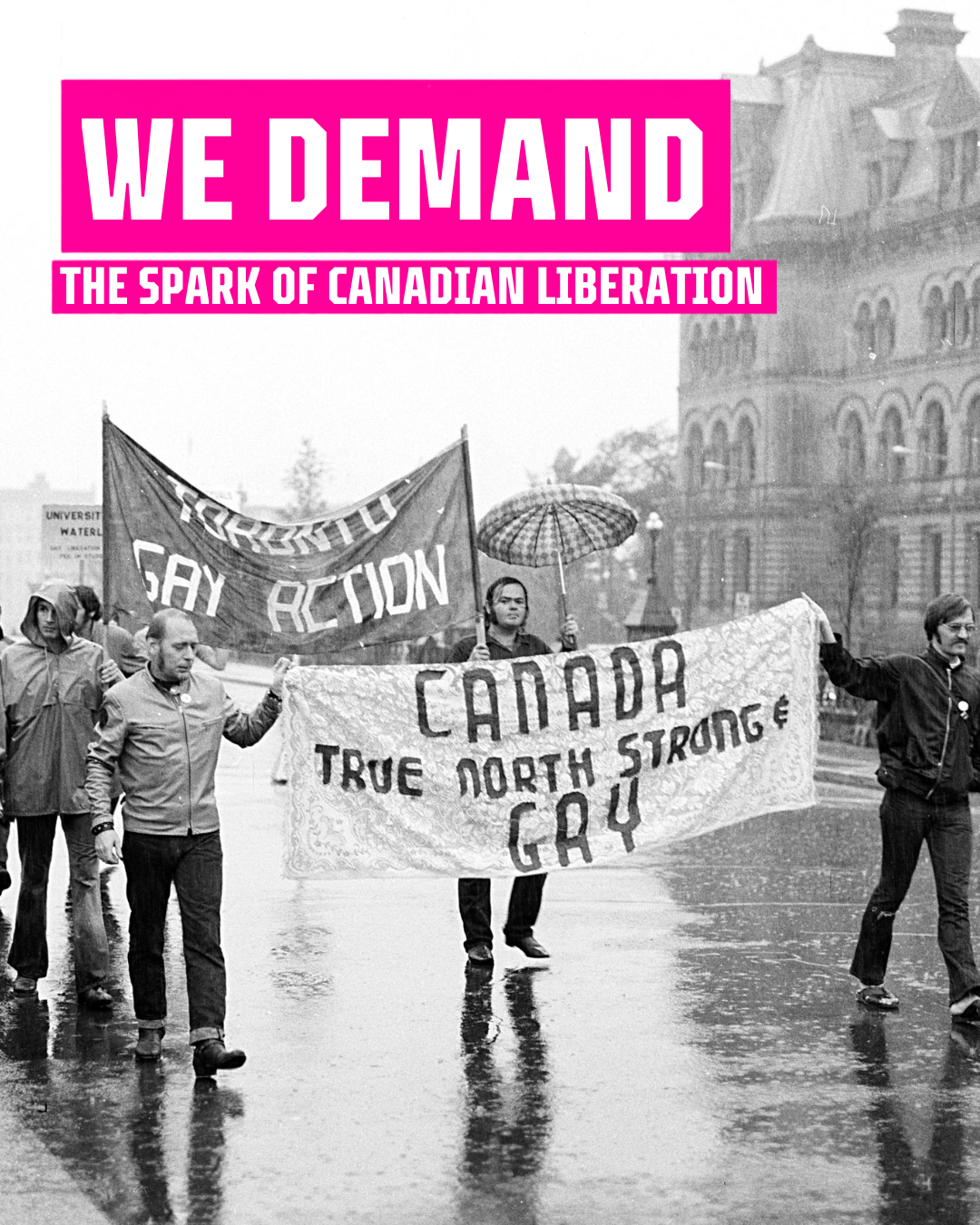

55 Years Since We Demand
In 2026, as Canada marks 55 years since the landmark We Demand march on Parliament Hill, its echo reverberates across generations of queer and trans activism. It stands as a testament to the power of grassroots resistance, uncensored storytelling, and a pivotal turning point in Canadian history where LGBTQ2+ individuals stopped asking politely for their rights and began to demand them—though not without immense cost and risk.
A Demonstration in the Rain On August 28, 1971, a small, courageous group of roughly 200 activists assembled in a downpour on the steps of Parliament Hill in Ottawa, while a parallel group demonstrated in solidarity outside the Vancouver Courthouse. Arriving on the second anniversary of Bill C-150—a 1969 Criminal Code reform that partially decriminalized private adult sexual acts—the protesters knew the reality on the ground was far from liberated.
Despite the government’s claim that it had no business in the bedrooms of the nation, state surveillance, police harassment, and systemic purges of queer people in the civil service and military actually intensified.
The 13-Page Brief Organized by groups like Toronto Gay Action (TGA) and the Community Homophile Association of Toronto (CHAT), the activists presented federal lawmakers with a radical 13-page brief titled We Demand. The manifesto outlined ten specific points, calling for:
The removal of discriminatory terms like "gross indecency" from the Criminal Code.
An end to the RCMP spying on and purging LGBTQ2+ federal employees and military personnel.
Equal employment, immigration, and child custody rights regardless of sexual orientation.
An end to medical and legal discrimination that classified homosexual acts alongside cruelty or bestiality.
Drafted by activists including Herbert Spiers, David Newcome, and Brian Waite, and signed by pioneers like Cheri DiNovo—the sole female signee bringing a vital feminist perspective—the document felt to its authors like it "wrote itself because it was obvious and just." Yet, to the public and government of 1971, these ten points amounted to an unthinkable "social revolution."
The Price of Standing Up Taking the steps of Parliament in 1971 meant risking everything. Many invited guests declined to attend out of valid fears of being outed, fired, policed, or publicly ostracized. In the years immediately following, mainstream society and even some members of the queer community—fearful of violent backlash—critiqued the demonstrators for making too much noise.
Progress was painfully slow. The initial victory came with the Immigration Act, 1976, which finally removed the ban on gay immigrants and visitors. But it was not until the early 1980s—when violent police bathhouse raids in Toronto ignited massive public uprisings—that the broader community fully galvanized behind the blueprint We Demand had laid down. Decades of strategic litigation, protests, and community organizing followed until every single one of the brief's original ten demands was eventually met.
The Birth of Queer Media and Modern Activism The legacy of We Demand extends far beyond legal reform. Disillusioned by how mainstream media censored and altered coverage of the march, demonstrator and photographer Jearld Moldenhauer—alongside figures like Ed Jackson—Editor of The Body Politic. The publication became Canada's premier gay liberation newspaper, cementing the vital link between uncensored media, community organizing, and political power.
Why the Echo Matters Today Fifty-five years later, the echoes of We Demand feel urgent once again. As modern debates over censorship, gender identity, and human rights resurface in school boards, legislatures, and public spaces, the history of 1971 offers both a warning and a blueprint.
It reminds us that rights are rarely granted freely by the state; they are forged by ordinary people willing to stand in the rain. As activists, creators, and allies gather to honor this 55th anniversary, We Demand serves as a permanent reminder: when a democratic society tolerates the oppression of one minority, all citizens are compromised. Resistance has many forms—and its echo carries forward through every story we refuse to let them silence.
🧠 Learn & Engage
💬 Share your message of inclusion in our Tour program.
🏆 50th Anniversary of Montreal Olympic Raids short documentary and curriculum toolkits
🏛️ 55th Anniversary of 'We Demand' Protest short documentary and curriculum toolkits
🎭 Lawrence Aronovitch's New Play script and post-show discussion guides
📥 Download campaign tools like posters, graphics, and more!
🛍️ Grab an INSPIRE T-shirt and limited-edition artwear by Marketing Therapy
💖 Donate to support free workshops and programming across Canada
🗣️ Let Your Voice INSPIRE
Use #DayOfPink2027 and #InspireChange to share your voice, your story, and your legacy. Because history isn't just the past—it's how we build tomorrow.